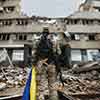
As the fragile ceasefire between Israel and Lebanon is trying to hold, the bombardment of Lebanon by Israel continues. There is no military compatibility between Israel and Lebanon, and the Lebanese are helpless. What seems to stand in between the Israel Defence Forces (IDF) moving north of the Litani River is Hezbollah. However, the conflict between Israel and Lebanon is not a matter of territorial dispute or Hezbollah, a proxy of Iran, supporting the Palestinian armed struggle. It is deeply rooted in history. The Time Magazine article of 14 April 2026 traced it to the 1948 Arab-Israeli War. This is somewhat misleading. The actual reason, however, dates to 1920 when a Maronite separatist movement envisioned a Maronite Christian homeland in Lebanon with the help of a Jewish state in Palestine. The Maronite homeland or supremacy was to minimise the Muslim presence, even if it required a slight modification of the border, giving away a portion of Lebanon and evacuating the Shiite population from South of Lebanon. This is exactly what is happening in Lebanon now.
The animosity between different factions in Lebanon is deep-seated. No doubt the local population in South Lebanon always suspected the Maronite Christians and looked at the United Nations Interim Force in Lebanon (UNIFIL) peacekeeping contingents from Europe through a different lens. The image of the massacre of between 2000 and 3,500 people at Shabra-Shatila refugee camp (Beirut) between 16 and 18 September 1978 is still fresh in the minds of Palestinians. It was committed by the right-wing Lebanese Maronite Christian militia, Phalange, with the direct support of the IDF.
1920 has now returned to haunt Lebanon, consuming even the Maronite Christians. As UNIFIL prepares to close, France is reported to have suggested establishing an international force under UN Chapter VII to replace UNIFIL. Lebanon is so complex that peace seems very far away. Marrack Goulding, then the USG of the UN in charge of peacekeeping, gave an apt account of the complexity in Lebanon in his book Peacemonger (London: Johns Hopkins University Press, 2003, p. 58). To understand it well, what he stated was somewhat like:
Think of Lebanon as a cockpit. But it’s not a normal cockpit. The fights are not single combats between two cocks; they are fights between teams of cocks, in ever-changing alliances. And the floor of the cockpit is strewn with brightly coloured beads. They are called ‘assets’, and they come in various colours—blue for political assets, yellow for economic assets, khaki for strategic assets, white for ideological and religious assets, red for criminal assets. Inside the cockpit, there are several resident teams of cocks. The four principal ones are the Maronite Christians, the Sunni Muslims, the Shiite Muslims and the Druze, a heretical Islamic sect. There are other lesser teams of cocks. Each team includes some fighting cocks, called ‘militias.’ The teams fight each other to accumulate and control as many assets as possible. Alliances between teams are frequently formed and dissolved. Sometimes, teams fight among themselves and split into two or smaller teams. The fights are violent and cruel; many team leaders are assassinated, sometimes by members of their team. Around the cockpit, there are several gamblers. The principal ones are Israel, Syria, Iran, and the Palestine Liberation Organisation (PLO). The lesser ones are Egypt, Iraq and Jordan. Like the resident teams, the gamblers’ objective is to accumulate and control assets in the Lebanese cockpit. Three of them (Israel, Syria and PLO) have, or have had, their fighting cocks in the cockpit. But all of them also hire the services of one or more of the resident teams, as does Iran and the lesser gamblers.
One wonders why Goulding did not name the Americans, the French, and the British among the principal gamblers. He possibly meant it! The complexity of Lebanon seems true, and even more so for the entire Middle East, with China and Russia playing critical roles in shaping the ongoing conflicts in Iran and what is happening in Gaza.
The Middle East was complex earlier, but relatively peaceful and stable under Ottoman rule for roughly 400 years. One of the most distinctive features of the Ottoman Empire was its approach to managing religious diversity, in which religious communities were granted autonomy over their internal affairs. Even though many historians may argue differently, it was relatively stable compared to what happened during the mandate period and what is seen today.
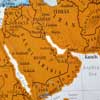
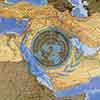
The Treaty of London (1915) and the Sykes-Picot Agreement of 1916, which covered different geographical areas (except for Anatolia), also played a critical role in shaping what the Middle East look like later. Firstly, both agreements were kept secret, meant to share the remains of the Ottoman Empire when the empire collapsed.
Secondly, there was a conflict over the partition of Anatolia (a major seaport in southwestern Turkey) between France and Italy. It was, however, later resolved by the Agreement of Saint-Jean-de-Maurienne (1917), followed by the Treaty of Sèvres, 10 August 1920 (for a more detailed account, please read “India and the strategic framework of the western Indo-Pacific” by Amb Asoke Mukerji). This is a different matter, as Italy did not get Anatolia because the Treaty was never ratified.
Thirdly, probably the most important is the string of lies surrounding British promises in the form of the agreements. This included promising to give Anatolia to Italy in 1915, Arab independence to Sharif Hussein in 1915 (the Emir of Mecca and the leader of the Great Arab Revolt against the Ottoman Empire during World War I), secretly agreeing to split the region with France (Sykes-Picot, 1916), and pledging a Jewish national home in Palestine (Balfour Declaration, 1917). It is worth noting what Amb Talmiz Ahmed says about Britain’s promise to Shariff Hussein in his book West Asia at War (Gurugram: Harper Collins, 2022, p. 65). According to him, the promise was made out of wartime considerations and after the war, Britain had no option but to accommodate Hussein’s sons as rulers in Iraq and Transjordan, even though they were not trustworthy. Such deceitful promises created confusion, a lack of trust and long-term conflicts between neighbours, reaching a breaking point, now accentuated by unilateral display of power by the US and Israel. It seems that Israel is leading the US by the nose. It is in the Trump administration’s interest to end the conflict as the midterm election approaches. But the continuation of the conflict in Gaza and Iran helps Netanyahu to survive.
The Middle East, known as the “cradle of civilisation” and the birthplace of the three Abrahamic religions, is endowed with strategic significance, connecting different civilisations through trade and commerce. For centuries, the region was the ground for contest. The discovery of energy resources in the early twentieth century further drew the attention of the competing powers, even though it remained relatively stable. But the partition of the region opened the door to chaos. For Britain, the main architect of the partition plan, the Middle East was the lifeline to India. Sykes and Picot divided the Ottoman Empire with a stroke of a pen (a similarity seen in the Radcliffe Line, which divided the boundary between India and Pakistan upon partition in 1947), ignoring geography, history, and family ties. Did they think of the impact of their action when someone wanted to rewrite history and redefine what peace means? To some, the presence of a threat is a source of survival.
Peace, if we consider it the absence of violence, is possible if the current younger generations become accustomed to a time without violence and prevent the “Joker or the jokers in the pack” from benefiting from the absence of peace.
Major General (Dr) A. K. Bardalai (Retd) is a former peacekeeper and currently a Distinguished Fellow of the United Services Institute of India. He holds a PhD in UN Peace Operations from The Tilburg University, the Netherlands.