The South Asian region is characterised by diverse countries with complex relationships driven by historical, cultural, economic and geopolitical factors. As the largest economy, India is critical in shaping regional dynamics. Besides India, China is the most important player in the region. Its economic clout and ever-expanding influence have impacted the regional dynamics in many ways. Many countries share historical and cultural links with other countries. Because of the complexities, while there are opportunities, there are challenges in terms of trust and coop eration, regional disparities and external influences impacting the internal dynamics of a nation as well as bilateral relations within the region. Closer home, India’s relationship with Bhutan is unique and different from other countries. The relationship among nations is not permanent. It changes as nations evolve. The Indo-Bhutan bilateral relationship is no exception. Despite many obstacles, Bhutan’s relationship with India even though still f irm seems to have reached a crossroads. Sandwiched between two large neighbours who are arch rivals, Bhutan must maintain a delicate balance. Tipping the balance towards China will be a security concern for India.
The Himalayan Kingdom of Bhutan, which is approximately 350 by 150 sq. km, is confined by two Asian giants—China and India. Bhutan was always an independent and sovereign state. Even the mighty British Empire could not conquer it. Bhutan’s relationship with India, which took root soon after India’s Prime Minister Nehru’s landmark visit to the country in 1958, has become stronger day by day. While shared history and culture are the enablers, the geopolitical compulsions of both nations are the main drivers of the strong bilateral ties. Being a landlocked country and devoid of many natural resources, Bhutan is forced to look outside its geographical boundary as the main source of revenue. Bhutan is trapped by two big powers, which pathologically do not see eye to eye. However, it has the choice to align its foreign policy to either side. Its decision to gravitate towards India seems to have come in the way of China’s ambition to exercise effective control over South Asia to create an alternate power centre of the current rule-based yet selective world order.
Bhutan has neither diplomatic relations nor has it demarcated its boundaries with China. Failing to push India from its special status inside Bhutan or to alter the balance, China has resorted to a combination of approaches to establish diplomatic relationships and coercion by illegally occupying substantial swaths of land from disputed areas inside Bhutan and near the Indo-Bhutan border. Because of the variance in the strategy of India and Bhutan to support their mutually beneficial core interests, the dragon now breathes fire on India’s strategic Siliguri Corridor, thereby bearing on the foundations of their bilateral relationship. China’s growing military threat to Bhutan and India in its quest for power in South Asia is clear and present.
After diving into the historical evolution of Bhutan, its geopolitical challenges, the Indo-Bhutan bilateral relationship and their shared history and culture, this chapter will explore the strategic options for both India and Bhutan to face these challenges. The author writes from a practition er’s perspective, being the former Commandant of the Indian Military Training Team (IMTRAT), Bhutan, from October 2011 to January 2014. He has closely interacted with members of the royal families, the govern ment, the Royal Bhutan Army (RBA), the Royal Bodyguard of Bhutan (RBG) and the local populace. The following analysis reflects more of his personal experience and insights gained during his assignment in Bhutan than any other account.
Historical Evolution of Bhutan
The early history of Bhutan covers the period from 4000 years ago till 600 AD, based on archaeological artefacts and available records. Bhutan is a Buddhist country. It was from the mid-seventh century to the mid seventeenth century when the foundations of Buddhism were laid in Bhutan by Guru Rinpoche and the unification of Bhutan as one nation after the warring factions were unified by Zhabdrung Ngawang Namgyal. Buddhism spread to Tibet from Nepal and northern India. However, the real transmission of Buddhism to Bhutan took place from Tibet through a series of Tibetan lamas, who travelled southward looking for solitude, tranquillity, hidden treasures and patronage. The well-known evidence of Bhutan’s link to Tibet can be found in the two temples of Jampa Lahkhang in Bumthang and Kyerchu Lahkhang in Paro. These temples were built by Songtsen Gampo, the 32nd King of the Yarlung dynasty, who ruled Tibet during the better part of the first millennium (Phuntso 2013). Construction of the temples, however, does not give any right to Tibet over Bhutan.
After the demise of Zhabdrung in 1651, Bhutan went into an eclipse, torn with civil strife under 54 different rulers till 17 December 1907, when Ugen Wangchuck, son of Jigme Namgyal, was crowned as the first hereditary King of Bhutan (Pradhan 2012; Imaeda 2013). Some of the important events thereafter are the signing of the Punakha Treaty in 1910; China’s occupation of Tibet in 1954; the Dalai Lama’s flight to India; China publication of a map with claims over Bhutan in 1961; the 1962 Sino-Indian war; the large cross border intrusion into Bhutan by Tibetan herders and commencement of border talks between Bhutan and China (Kaul 2022; The Treaty of Punakha 1910).
India and Bhutan: Shared History and Culture
Understanding history and culture helps comprehend the past, the present and can generate visions for the future. Even though the shared history and culture between India and Bhutan are limited, it has influ enced the growing relationship, which is different from other bilateral relations in the Himalayan subregion. The Indo-Bhutan relationship is also the legacy of Bhutan’s relations with Britain, which began when Bhutan clashed with the British colonial power. Around a century of increasingly tense relationships over the Assam and Bengal Duars culmi nated in the Treaty of Sinchula of 1865, which was renewed as the Treaty of Punakha in 1910. This was again renewed as the Treaty of Friendship in 1949 after India gained independence. The visit of HM Jigme Dorji Wangchuck, the third King of Bhutan, to India in 1954 and his long standing invitation to the first Indian Prime Minister, Jawaharlal Nehru, finally materialised in the latter’s visit to Paro in September 1958 as a landmark event in the Indo-Bhutan relationship (Mehta 2002). Defence cooperation between India and Bhutan began even before the establish ment of the formal diplomatic relationship in 1968. Project DANTAK was launched on 24 April 1961 to construct and maintain roads inside Bhutan. It was followed by the establishment of the Indian Military Training Team (IMTRAT) on 23 October 1961 for the training of personnel of the RBA and the RBG.
Buddhism is important in strengthening the bond between India and Bhutan. Guru Rinpoche, also known as the Second Buddha, who took Buddhism to Bhutan, was an Indian. The Buddhist sect followed in Bhutan is also influenced by some traditional practices of India. According to Dasho Karma Ura, to the common Bhutanese, whose worldview is shaped by Buddhism, India is regarded as the point of origin of Buddhist knowledge and literature, translated and transferred to Tibet and Bhutan (Ura 2014; Pradhan 2012). Education is another area that has fostered a very strong bond between India and Bhutan. In earlier days, when Bhutan’s connectivity with other parts of the world was not so good, many students walked for miles and days to reach the foothills to study in some of the renowned schools in India. The list included even Her Majesty the Queen Mother (Wangchuck 2006). Because of the stories of some fine teachings about the dignity of labour and integrity in Graham’s Homes School in Kalimpong that the author used to hear from a few well-known personalities in Bhutan, he decided to visit the school in 2013. Sadly, the feeling of enthusiasm that he received from his friends in Bhutan was missing in the school. One wonders why Graham’s Homes School, which produced two prime ministers, two chief justices, a few generals and one cabinet secretary of Bhutan, among many more, did not take pride in its contribution. The school probably took its achieve ments as a favour to the students of Bhutan and not as a service. Even as early as 1914, Bhutan sent forty-six boys to India for western education.
Bhutanese students were beneficiaries of Indian teachers who travelled for weeks in 1961 to teach in remote schools in Bhutan. But, Bhutan did not forget this. As a mark of respect, forty-three retired teachers joined the Bhutanese Teachers’ Day celebration in 2018 (Tobgye 2018). Students from Bhutan who studied in India took pride in waving the Indian Tricolour. Gratitude is another innate cultural strand that runs in the veins of the Bhutanese population.
The student-teacher community, which immensely benefited from each other’s cultures, was an important link between India and Bhutan. However, along with better communication and more opportunities for Bhutanese students to travel to places across the continent, there has been a consequent reduction in the number of seats in Indian educational insti tutions (Shivamurthy 2025). Sadly, even the memory of this community’s benefits is now almost extinct. However, it is still possible to revive that connection if the history is passed down to new generations, especially at a time when the change in the global view of education seems to have impacted the students of developing countries. Apart from this, on its part, India will have to offer Bhutan in civilian educational institutions as well as military training establishments something new and better than what others can offer and what it is presently offering.
Geopolitical Challenge
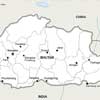
Bhutan is a landlocked country in the eastern Himalayas with China and India to its north and south. With 350 km from east to west and 150 km from north to south, the total area of the country is 38,394 sq. km. The peculiarity of the country is the pronounced differences in nature and landscape within a small area. Valleys are separated by mountains ranging from 7500 to 100 m from north to south. The country is generally mountainous except for a small strip of land in the south. The two impor tant ranges of Black Mountain and Thumsingla trisect Bhutan into the western, central and eastern sectors. Inhospitable terrain has forced the country into complete isolation, thereby engendering a unique identity. Geographical location plays an important role in determining the foreign policy of countries. Bhutan is a small and landlocked country, devoid of natural resources. Therefore, its destiny is interlinked to its two big neigh bours and emerging world powers—India and China. As a result, Bhutan finds itself in a complex situation, having to conduct its foreign policy delicately, balancing its strategically preponderant position.
Ensconced between the Tibet Autonomous Region (TAR) of China and India’s northeast, Bhutan shares a 470 km border with China and 605 km border with India. The northern border with China is gener ally glaciated around the year and therefore, of little strategic importance. Similarly, being inaccessible, the eastern boundary with India has also not drawn much attention. However, the northwestern boundary with TAR has been in the limelight and is of strategic importance to all three countries. Besides India, China has an ongoing boundary dispute with Bhutan. China presently has a total of 764 sq. km. of disputed terri tory with Bhutan. Of this, 269 sq. km. lie in the strategically important northwestern sector and 495 sq. km. in the glaciated central areas of Paksamlung. Inclusion of the northwestern sector in China will result in obvious security implications for India in its northern border. Widening of the Chumbi Valley will provide more elbow room to the People’s Libera tion Army (PLA) and reduce its vulnerabilities from India inside the valley. It, in turn, will reduce the distance between the southern tip of Chumbi Valley and the Siliguri Corridor, thereby making the corridor and the eastern Sikkim sector more vulnerable.
The lay of the ridges is from the north-west to the south-east, and there is only one major road connecting east to west. Nearly all inter sectoral movement in Bhutan is through the plains of Assam and West Bengal; and its entire commercial activity is routed through India. This unique topography, combined with India’s non-aggression policy, makes Bhutan more dependent on India. The relationship between India and Bhutan, which can be defined as beneficial bilateralism, has only been growing. The origins of Bhutanese people can be traced back to the Mongoloid race. Their religion, Buddhism, though born in India, reached Bhutan through Tibet. But the sect of Buddhism followed in Bhutan— the Drupka Kagyu, is distinct from that of Tibet. This sect was made the official religion of Bhutan by Zhabdrung Ngawang Namgyal, who was a politico-religious refugee from Tibet; he united the country in the seventeenth century. In combination with its self-imposed policy of isola tion, Bhutan has been able to maintain its distinct national, religious and cultural identities. At the same time, it is also the aspiration of the popu lation in the border areas to commence border trade along the traditional trade routes from the TAR into Bhutan.
Bhutan has always been conscious of maintaining its identity as a sovereign country. It also wants to settle the boundary dispute with China. But to do this without compromising the security needs with India, on whom Bhutan is dependent for trade, commerce and aid, is a big political and diplomatic challenge. This challenge further gets compounded because of the likelihood of the spillage of insurgent groups of India along the southern border from the Indian side into the Bhutanese side, in search of safe havens. Also, because of the limited human (with a population of around seven lakhs) and meagre natural resources, the Bhutanese economy remains heavily dependent on foreign aid. Hence, Bhutan is compelled to explore other alternatives, such as the generation of hydropower mostly with support from India. Therefore, even though shaping Bhutan into a self-sustaining economy is a challenge, it has not been impossible.
The ushering of democracy in 2008 and economic development in the past decades have brought along with them a vociferous media and popular representation. This was previously unknown in Bhutanese society. The reach of the common Bhutanese, earlier limited to India, because of both geographical and economic reasons, has now gone beyond the continent. Accordingly, aspirations of the general Bhutanese population have changed, with their expectations rising high. Despite being a monarchy, Bhutan is a young and vibrant democracy. The demo cratic practices in Bhutan, however, are slightly at variance from India. Bhutan believes in seeking accountability from its elected representatives. Sondhi observed that the participatory notion of democracy does not begin and end with the electoral process to bring a political party to power. Participatory democracy reflects its political will, grievances and interests of the common man in the body politic and seeks constant accountability from its elected government (Sondhi 2024). The democ racy in Bhutan, as seen from the past three national elections, has imbibed a healthy culture of seeking accountability from the elected representatives which is worthy of emulation by its neighbours.
hich is worthy of emulation by its neighbours. India’s relationship with Bhutan, to some extent, has been shaped by its shared historical and cultural linkages. While shared linkages have helped to forge a strong relationship, geopolitically, it is beneficial for both nations to remain on good terms. Interestingly, there is also the influence of China—soon after India’s victory in the 1971 war with Pakistan, the then-PM Indira Gandhi believed that India would earn China’s respect and possibly improve bilateral relations (Sondhi 2024). It never happened. India had fought two major wars with China in 1962 and 1967. Even after 1971, skirmishes along the borders have continued. The last conflict, even though localised in the Ladakh region, took place in June 2020 in Galwan Valley. Being Bhutan’s northern neighbour, an understanding of the Indo-Bhutan relationship will remain incomplete without factoring in China.
The China Factor
Historically, Bhutan’s relation with Tibet, never particularly good, was strained considerably when Bhutan sided with Britain in the early 1900s. Trying to secure its south-western flank against increasing foreign aggres sion, China claimed a vague suzerainty over Bhutan in the period before the Revolution of 1911. The new Republic of China let the claim lapse and it was never raised again publicly. After its independence in 1947 and the post-Sino-Indian conflict in 1962, when India’s relations with Bhutan started to grow, this caused worries for China. To alter this equa tion and dislodge India from this strategic space of Bhutan, China evolved a strategy which includes solving the boundary dispute to secure the south-western flank, establishing diplomatic relationships and increasing/ enlarging the scope of bilateral trade with Bhutan. Promoting tourism and various other bilateral exchange programs also form part of this strategy.
In pursuit of this goal, China resorted to military and non-military activities like illegal intrusion and the construction of roads inside and outside the disputed areas. China also offered a territorial concession to solve the boundary dispute to increase its sphere of influence in Bhutan. Desperate to get an inroad inside Bhutan, China has come up with several initiatives, including tourism and commencing trade along the Tibet-Bhutan border, mostly through the Paro Valley. China has also evinced interest in investments in the energy and engineering sectors. The proposal for trade in the border areas is in addition to the ongoing busi ness venture inside Bhutan, which has already been in place for quite some time. Unfortunately, the disputed areas and lack of substantial progress in the boundary talks have come in the way of achieving this goal.
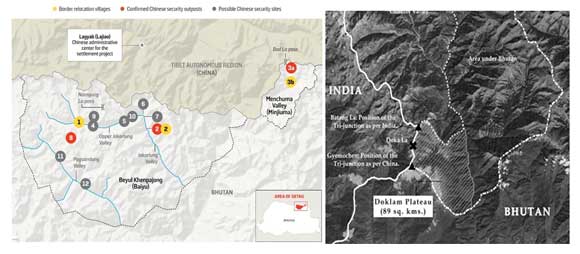
Failing to settle the boundary and establish a diplomatic relationship, the PLA has illegally intruded into western Bhutan (east of Chumbi Valley), developing surface communications and military infrastructures to increase the size of the Chumbi Valley and, thereby create more space for manoeuvring for the PLA inside the Valley. Besides static bases, PLA patrols regularly visit the disputed areas as a show of force. The situation came to a head when, on 8 June 2017, PLA troops crossed over to the Bhutanese territory with road construction machinery to build a motorable road connecting the Chumbi Valley with the Doklam Plateau. In response, the Indian Army from the nearby Sikkim garrison quickly moved inside the Bhutanese territory and prevented the PLA from constructing the road. The stand-off continued till 28 August when both countries agreed to pull back their troops, with the Indian media attributing this as a diplomatic victory for the country.
Sino-Bhutanese boundary discussions have been going on since 1984, and so far, 25 rounds of boundary talks have taken place without making much headway. Both sides have come up with different claims and counter-claim. All the claim lines of China included the Doklam Plateau. When nothing moved forward, in 1996, China offered to barter its claim over the northern sector against the northwestern sector. It also wanted to shift the tri-junction from Batang La to Gemoychen. Interestingly, while the talks were on, China gradually encroached on Bhutan. Encroachment in the northern sector, by and large, went unnoticed as these are outside the immediate area of influence of the Indian Army. China, however, moved cautiously when it came to Doklam. What happened in June 2017 is now history (Bardalai 2017, 2018a, 2018b). In the northern area, being glaciated and difficult to access, China’s offer of exchange of terri tory was not taken seriously. But when China added spiritual content to the not-so-important disputed areas in the northern sector, the matrix changed. It was done by illegally occupying the Beyul region in northern Bhutan for the settlement of Chinese Tibetans.
A vivid description of the Chinese project in the disputed area can be found in the research report of Barnett (2021) and Bardalai (2024). Beyul means ‘hidden valley’. It was concealed by the legendary Guru Rinpoche, the Second Buddha in Bhutan (Phuntso 2013). The legend further goes that the Beyuls are only discoverable by those with heightened spiritual powers. According to local legends, Beyuls are meant for the Bhutanese to take refuge when the world comes to an end. Besides, the father of the first King of Bhutan was born in the Beyul region. Being religious, cultural and for their emotional attachment to their Kings, the Beyul region is an area that the Bhutanese are not going to give up. China claims this region as part of the TAR, even though it is inside Bhutan. According to Barnett, Project Gyalaphug or Beyul Khenpajong includes three new villages—two already occupied, one under construction—new roads, a small hydropower station, two Communist Party administrative centres, a communications base, a disaster relief warehouse, five military or police outposts, a satellite receiving station, a military base and up to six security sites and outposts. Incidentally, the work for this village began 5 years earlier than than Pagda village, which came up along the Amouchu River inside Bhutanese territory after the Doklam standoff. By then, work in Gyalaphug was already more than halfway through.
The second enclave for settlement by China in Northern Bhutan is in Menchuma Valley, around 2 km to the east of the Beyul Khenpa jong—spanning 19 square miles, this region is at an altitude of more than 14,700 feet and lies in the Lhuntse district. Until now, it has never had settlements, roads, or buildings. The third enclave of Chinese construc tion is Jakarlung Valley, which is west of Beyul Khenpajong. China had set its eyes on the Beyul region as early as the mid-1950s. There are stories about Tibetan yak herders moving to Bhutan’s traditional grazing ground and later claiming the generally uninhabited lands. But one story, as learned from one of the author’s close friends in Bhutan, is slightly different from what Barnett had to state. Four Bhutanese Tibetan fami lies of the Beyul region were entrusted with looking after four yak herds belonging to the noble families. These families used to cross over to Tibet for grazing and were also involved in cattle rustling. Sometime later, two families, or maybe all, stole the same herds which were their responsi bility to protect and moved to a village called Lagyab in Tibet. In 1995, the same herders were asked by their Chinese masters to cross over and to go and live year-round in the Beyul region along with their stolen yaks. Later, Chinese media applauded the four nomads’ dedication to discovering their sacred land, which had been hidden since ancient times.
The areas of the Beyul region under Chinese occupation are not very far from Bumthang, which is almost midway on Bhutan’s west east lateral and known as the cultural and religious heartland of Bhutan. Further slicing of the Bhutanese territory will present a new security threat to Arunachal Pradesh from the west. Other than Doklam, all areas are outside the immediate area of operations of the Indian Army. Since Doklam has always been at the centre of discussions on the threat to the Siliguri Corridor, it needs some explanation.
The Chumbi Valley, a narrow strip of land with only a few kilome tres at its narrowest point, has been an Achilles’ heel for China. What drives China is its desire to delineate its boundary with Bhutan—coupled with enlarging the size of the Chumbi Valley by annexing a large portion of Bhutanese territory—is the fear of being cut off by the Indian Army from the west as well as in the east, the latter in collusion with the RBA. The failure to settle the boundary despite 25 rounds of talks, as well as its inability hitherto to alter the Indo-Bhutan friendship equation, has created a sense of unease for China. As far as India is concerned, the enlargement of the Chumbi Valley will enhance the PLA’s threat to its Siliguri Corridor. This is not a new threat; there existed such a threat even in 1950. Claude Arpi quotes from a classified communica tion from Hariswar Dayal, the then Indian Political Officer in Sikkim, to India’s Ministry of External Affairs of India (MEA) on 21 November 1950, 1 month after the PLA invaded Tibet and occupied the town of Chambdo:
An attack on Sikkim or Bhutan would call for defensive military operations by the Government of India. In such a situation, occupation of the Chumbi Valley might be a vital factor in defence. In former times, it formed part of the territories of the rulers of Sikkim, from whom it was wrested by the Tibetans by force. It is now a thin wedge between Sikkim and Bhutan, and through it lie important routes to both these territories. Control of this region means control of both Jelep La and Nathu La routes between Sikkim and Tibet, as well as of the easiest routes into western Bhutan, both from our side and from the Tibetan side. It is a trough with high moun tains to both east and west and thus offers good defensive possibilities. I would therefore suggest that the possibility of occupying the Chumbi Valley be included in any defensive military plans, though this step would NOT, of course, be taken unless we became involved in military operations in defence of our borders (Arpi 2015).
Dayal’s suggestions were not accepted. However, as prophetic as it seems, more than six decades later, there is considerable change, not just in regional geopolitics but also in India’s economic and military status. Doklam (or Zhonglan or Donglong) is a plateau within Bhutanese terri tory near the Bhutan-China and Bhutan-China-India border. If this area falls into the hands of China, it will provide a huge military advantage to the PLA. Besides enlarging the size of the Chumbi Valley, its distance to the higher ridges (within Bhutan) overlooking the Siliguri corridor will be reduced. In fact, across all the claim lines and counter-claim lines made by China to Bhutan as part of the boundary discussions, Doklam has been the constant factor. China has already offered a package deal—to forego its claim to a portion of the disputed areas in central Bhutan in exchange for the Doklam Plateau—between 1990 and 1996. Therefore, China is not likely to vacate the area it has already occupied further north of Chumbi Valley, as well as the area inside Doklam Plateau, from where the PLA did not pull back even after August 28, 2017 (Bardalai 2024).
The author has previously suggested that Doklam was initiated by China to probe and gauge India’s response and, thereafter, recalibrate its defensive posture to make it more challenging for the Indian Army in future standoffs (Bardalai 2018a, 2018b). After the disengagement, the PLA never moved out of the area. On the contrary, it has built perma nent infrastructures for approximately 3000 troops. The PLA soldiers occupying the plateau are vulnerable to Indian Army positions on higher ground to their west and the Gymochen tri-junction. To improve its defensibility, the PLA will have to either move to higher grounds to the south or force Bhutan to delineate the boundary. On the other hand, for India, a threat to the Siliguri Corridor has only increased. As mentioned above, the threat to the Siliguri Corridor was always there. Dayal’s sugges tion to occupy Chumbi Valley not only highlighted the imminent danger of a PLA threat, but at the same time, it managed to sensitise China to a likely military threat from India. To the military thinkers, both in uniform and some outside the services, the PLA threat has come closer and is clearer than before. The worst case scenario involves the PLA’s decision to occupy the higher ridges (Jampheri) for mitigating its tactical vulnerability from the Indian Army. Therefore, the gravity of any threat to the Siliguri Corridor due to an enhanced PLA presence on the Doklam Plateau also must be seen in the context of China’s fear of India’s military threat to the Chumbi valley.
It is worthwhile to share what a common Indian citizen feels about the threat to the Siliguri Corridor. Sometime back, when the author was returning from the University of North Bengal, Siliguri to catch a flight from Bagdogra, during a casual conversation, the driver of his car explained the new road from Kolkata that was under construction then. He amplified his explanation by highlighting the importance of the Siliguri Corridor and China’s threat to it. When the author asked him what he thought of it, he stated ‘Aab woh time nahi raha’ or ‘the times have changed’. Indian citizens are reposing tremendous faith in the in abilities of the Indian Armed Forces to be able to face whatever threat lingers from the PLA.
As mentioned earlier, China aims to dislodge India from its influen tial position in Bhutan. It followed a multipronged strategy that included establishing diplomatic and trade relations with Bhutan and permanently demarcating the boundary. This is the author’s view that establishing diplomatic relationship and increasing trade and commerce are only a matter of time. Settling the boundary dispute was always a challenge because Bhutan would never take a suo moto decision without factoring India’s security concerns. Now that the PLA has illegally occupied a substantial part of Bhutanese territory, has it impacted the bilateral rela tions between India and Bhutan? This will be discussed in the next section.
China’s Illegal Intrusions into Bhutan and Indo-Bhutan Relations
The Indo-Bhutan bilateral relationship, which was the legacy of Bhutan’s relation with the British, grew after India gained independence in 1947. There are also limited linkages of shared history and culture between the two nations. Since Bhutan’s culture is centred around Buddhism, which came from India, this undoubtedly is the most common binding factor. However, if shared history and culture could bring nations closer, India’s relations with Pakistan and Nepal would have been different. Historically and culturally, there are more similarities between India, Pakistan, and Nepal than between India and Bhutan. Yet, despite the historical link that was established only post-1947 and the limited cultural similarities, the bilateral relationship between India and Bhutan is better.
Nations always have a choice to either align or remain non-aligned in their foreign policy. Geopolitically, it suits both India and Bhutan to remain on good terms. It is often stated that the shared historical and cultural linkages have influenced Bhutan to look south. It economically benefits Bhutan to do business with India. This is the author’s impression that the pull that attracts Bhutan towards India is driven more because of Bhutan’s faith in the absence of the idea of cultural and military imperialism on the part of India. In the case of China, it is just the oppo site. As mentioned in the preceding section, Bhutan’s culture is driven by the Buddhist faith. Even though Guru Rinpoche was an Indian and Buddhism was exported to Bhutan from India, Buddhism is a minority religion in India. Therefore, Bhutan is assured of India’s lack of capability to leverage Buddhism for influencing the internal dynamics of Bhutan. As for military imperialism, historically, India has not favoured the practice. The liberation of Bangladesh from erstwhile West Pakistan in 1971 and foiling the coup in the Maldives in November 1988 are two such exam ples (Sharma 2024). If the equation—absence of military imperialism—is changed either by intent or even accident, it will be considered a breach of faith by the population of Bhutan, forcing the government of Bhutan and the RBA to walk the tight rope.
On its part, India does not participate in the Sino-Bhutan boundary talks and trusts Bhutan to factor India’s security interests into all discus sions. It is presumed that the minutes of all boundary talks are shared with India immediately after every meeting. Other than putting across its posi tion (factoring in India’s position), Bhutan does not have any leverage to influence China’s position. On the other hand, failing to settle the boundary, China has used the PLA to illegally occupy a substantial area in western Bhutan, much before the Doklam standoff. Bhutan is a demo cratic nation and is answerable to its population, whose vision extends beyond the Indian subcontinent. The modern generation, not influenced by Indian education anymore, may not even find establishing diplomatic relations with China wrong. The desire of the democratic government of Bhutan to solve the boundary problem permanently seems to hint that the strategic partnership between Bhutan and India has reached a crossroads.
Not being able to comprehend the internal dynamics of Bhutan and its population’s desire, it is not uncommon to find irresponsible media outlets looking at the public statements of Bhutan with suspicion. For example, when His Majesty Jigme Khesar Namgyel Wangchuck, the King of Bhutan, visited India from 3rd to 10 November 2023, a section of the Indian media portrayed it as Bhutan trying to mollify India on the eve of a possible border deal with China (Joshi 2023; Wangdi and Sharma 2023). Bhutan’s former prime minister, Lotay Tshering’s remarks that China and Bhutan were inching towards completing their 3–3-Step roadmap earlier had created fear in the minds of the Indian population about a possible trade-off between Chinese claims in the Doklam Plateau (located at the Southern tip of the Chumbi Valley inside Bhutan and nearby of the tri junction between India, Bhutan and China) and the ones in northern Bhutan (Haider 2023). The comments of the Bhutanese Prime Minister to a Belgian newspaper that it was ‘not up to Bhutan alone to solve the border problem. There are three of us’, were viewed negatively by those who are far away from the truth. Until now, even though it will be logical to conclude that decisions taken by Bhutan on the boundary talks have been in consultation with India, Bhutan has never named India officially. At the same time, China claims that ‘India has always been the reason for the delay in negotiations on boundary issues between China and Bhutan’ (Siqi et al. 2021). Therefore, the Prime Minister of Bhutan's public acknowledgement of India’s stake in the boundary demarcation should have drawn accolades instead of brickbats (Bardalai 2024).
Eyebrows were raised again when India’s Prime Minister paid a state visit to Bhutan on 22–23 March 2024, just before India’s national elec tions. According to official statements, this visit was in ‘keeping with the tradition of regular high–level exchanges between India and Bhutan and the Government’s emphasis on its Neighbourhood First Policy (Ministry of External Affairs, Government of India 2024). Most other national media picked up the thread and followed the line. While a head of government visiting another country just before the all-important parlia mentary elections, unless it is a national emergency, is intriguing, it attaches importance to the impact of the boundary demarcation on the strategic partnership between India and Bhutan. Essentially, a one-sided trust deficit seems to have crept in between the erstwhile closest friends. Trust among friends is mutual and not one-sided. From his personal and frequent conversations with his friends (both civilian and military), as well as bureaucrats, the author gathered the impression that simply in return for the economic assistance, India expects unflinching loyalty from Bhutan and to stand up to China on its behalf, no matter if it is not within the military capability of Bhutan. The size of the RBA is just over 11,000 soldiers that including around 1,000 from the RBG, who are not available for any operational duties. Not being able to feel the Bhutanese culture and making bilateral relations transactional can damage good relations.
Even so, Bhutan is proud of its sovereignty. Pride in its sovereignty and respect for others are other important cultural traits in Bhutan. There is no better example than the events preceding the ‘war of duars’ between British power and Bhutan in 1865. Since populating and farming the fertile lands near the duars would generate revenue for East Bengal, on 11 November 1841, the British decided to annexe seven Assam Duars comprising an area of 1600 square miles (with a balance of 11 duars in Bengal) in exchange for Rs. 10,000/- per annum (Phuntso 2013). This arrangement was not liked by Jigme Namgyal, who was the Trongsa Penlop, the Governor, under whose jurisdiction the Assam Duars fell. The situation deteriorated and the British deputed Ashley Eden to conclude a treaty between Bhutan and the British. The mission set off on 4 January 1864 from Darjeeling, despite being unwelcome. After a treacherous journey, it reached Punakha on 15 March 1864. The events that followed the arrival of the mission until 29 March, when the mission left Punakha, took an interesting turn. Jigme Namgyal, the powerful ruler of eastern Bhutan, demanded that the treaty include the clause of return of the Assam Duars. The authentic account of the humiliation of Ashley Eden, the leader of the British mission, in the hands of Jigme Namgyel and Wangdi Dzongpon, during the mission’s stay at Punakha between 15 and 29 March 1864 can be found in Bhotan and the Story of the Dooar War (1866) by David Field Rennie, the Staff Surgeon with the corps (Rennie 1866: 124–126; Phuntso 2013). One day, when the negotiation did not progress as desired, Jigme Namgyal rubbed Eden’s face with a wet dough, pulled his hair and slapped his back. The Dzongpen, head of the Wangdi Dzong, went a step further by spitting and applying the chewed beetle nut on the face of Doctor Simpson, who was a member of the mission. Jigme Namgyal threatened Eden with imprisonment and shouted that he would prefer war to sign a treaty that did not cater for the return of the Assam Duars to Bhutan. Only someone proud of their country’s sovereignty could have the courage to stand up and defy the might of the British without worrying about its consequences. Jigme Namgyal’s son became the first King of Bhutan.
Despite their polite behaviour, the people of Bhutan, like Jigme Namgyal, are equally proud of their freedom and culture. Among the people of Bhutan, who are very proud of their sovereignty, this story is like folklore, which they proudly tell everyone who visits Bhutan. Depending on the situation, capability and temperament, hurting some one’s pride can evoke different forms of reactions, such as expressions of anger, pulling away or shutting down communications.
Another important factor is the practice of democracy in Bhutan. Despite the presence of the monarchy, Bhutan is a young and vibrant democracy. The democratic practices in Bhutan, however, are slightly at variance from India. As mentioned earlier, Bhutan believes in seeking accountability from its elected representatives. Accountability applies even to the King, who is the head of the state. Article 20 of the Constitution of the Kingdom of Bhutan stipulates that ‘[T]he Druk Gyalpo shall abdi cate the Throne for wilful violations of this Constitution or for being subject to permanent mental disability, on a motion passed by a joint sitting of Parliament’, following the procedure vide several sections of the document. In democratic governance, where accountability is at the centre and the voice of the population gets stronger day by day, the posi tion of the government at times comes into conflict with neighbouring nations. Hence, despite sharing history and culture and a common secu rity objective, the very foundation of the bilateral relationship can become the victim when the key aspects of democracy, such as accountability, are prioritised.
The bilateral relationship is like building a dream house. It takes years to build our house brick by brick, to cure, to plaster, to paint, and the choicest of interior designs before it is ready for the owner to move in. Once the dream house is ready, after about a year or so, depending on the quality of the construction, hairline cracks appear on the outer walls of the house. Unless the cracks are filled on time, there will be seepage of water and probably creepers will also take root. Then the house will crumble. For repair work to last, skilled workers like the mason, the plumber, the electrician, and the painter will have to be summoned again. These are the ones who built the house, and recalling their memory, can identify the defects and suggest the appropriate solution. This would be possible provided their contribution is not erased from memory. Like the effect of the environment on the dream house, external factors can damage a good relationship. The bilateral relationship must be nurtured and not taken for granted. Good bilateral relationships can help achieve national secu rity objectives to some extent. As nations evolve, their national interests indeed expand and transform, leading to shifts in the priority of the objec tives. When a nation reorders the priority of its objectives, it can trigger a need for adjustment in strategies, resulting in far-reaching consequences for the nations involved and the very foundations of the bilateral relation ship. When that happens, apologies, forgiveness and a nuanced, mutually convenient perspective assumed for the greater good can help amelio rate the damages wrought by time. For the people of India, apology is the supreme manifestation of the spirit of non-violence. Whereas, for the people of Bhutan, forgiveness is a divine gift or an act of divine grace. The primary responsibility for this lies with the respective governments to nurture the relationship. However, it is the population that can give a name to the relationship instead of making it transactional by providing space to the other, respecting their aspirations, sensitivity and treating them as equals and not beneficiaries.
Conclusion
Despite the limited shared historical and cultural linkages, the Indo Bhutan relationship is unique in the Himalayan region. Even though the relationship began only after India became independent in 1947, there were and still are attempts by external forces to dislodge India from its special place in Bhutan. Nonetheless, the relationship has been growing ever since. Bhutan has remained firm and unmoved in the face of military coercion from its northern neighbour. The equation of bilateral relation ships is not constant. Set off by shifts in geopolitics and evolving national interests, there will be ups and downs in bilateral relationships. The Indo Bhutan bilateral relationship is not an exception. There can be obstacles, even in the military-to-military relationship. Such challenges are not insur mountable. Sitting down across the table and engaging with each other to find an alternative solution to any security problem with humility in accepting the others’ point of view will rebuild the lost trust.
One of the reasons for the current global geopolitical shift is the rise of the Global South, which has long been marginalised in the world order established in 1945 (Hogan and Patrick 2014). As these nations stand up to reclaim their rightful place, India plays a vital role in amplifying their voices and promoting a more inclusive world order. Advocating the cause with humility to make it inclusive can position India as a bridge between the Global South and the rest of the world, rather than a leader. This approach will likely find better acceptance among Global South partners.
Humility is important. When humility is taken as a compulsion and the desire to be independent as ungratefulness, the meaning of gratitude will be lost. Gratitude to the parents, teachers, elders, predecessors and friends for what they have handed down to us is the hallmark of good rela tionships. Gratitude helps in acknowledging past support and assistance, which builds trust and strengthens bonds between countries.
The words of His Majesty the Fourth King of Bhutan, which still resonate in the author’s mind, are that in bilateral relationships, when the goal is the same, the strategies to achieve that goal must be aligned. This needs trust. Because friends must trust each other. Trust is a corner stone of effective diplomacy and long-lasting partnerships. The IMTRAT, whose primary role is in training the RBA and RBG, is better positioned to help build such trust. The IMTRAT’s role in supporting RBA training has, however, evolved. Given the RBA’s seven decades of growth into a capable force, the IMTRAT should shift focus towards new areas such as facilitating information sharing and disaster management support etc., instead of a training mentor. At a time when the bilateral relationship seems to have reached a crossroads, such a reorientation will help foster India-Bhutan military ties, ultimately as the indispensable conduit for strengthening bilateral bonds. Shared history and culture can help bring nations closer together. But progress in bilateral relationships is neither one-sided nor mathematical. It is a shared responsibility.
Source: https://foreignpolicy.com/2021/05/07/china-bhutan-border-villages-security-forces/
References:
Arpi, Claude. 2015. Occupy Chumbi Valley: A Top-Secret Cable from
Harishwar Dayal. Indian Defence Review. http://www.indiandefencereview.
com/news/occupy-chumbi-valley-a-cable-from-harishwar-dayal. Accessed on
31 Oct. 2025.
Bardalai, A. K. 2017. Face Off at Doklam Plateau: Implications for India
and Bhutan. Science and Technology Forum, Manipal University, 10 July.
https://stsfor.manipal.edu/why-china-encroaching-bhutan/. Accessed on 3 1
Oct. 2025.
Bardalai, A. K. 2018a. Doklam and the Indo-China Boundary. Journal of Defence
Studies 12 (1): 5–13. http://idsa.in/jds/jds-12-1-2018-doklam-indo-china
boundary. Accessed on 31 Oct. 2025.
Bardalai, A. K. 2018b, November 22. India-China Relations: Is There a
Thaw? Science and Technology Forum, Manipal University. https://stsfor.man
ipal.edu/safeguarding-indo-pacific-trumps-disruptive-tactics/. Accessed on 31
Oct. 2025.
Bardalai, A.K. 2024. Bhutan’s Border Demarcation with China: Impact of Indo
Bhutan Strategic Partnership. USI Journal CLIV/636.
Barnett, Robert. 2021. China Is Building Entire Villages in Another Country’s
Territory. Foreign Affairs. https://foreignpolicy.com/2021/05/07/china
bhutan-border-villages-security-forces/. Accessed on 31 Oct. 2025.
Haider, Sushani. 2023, October 7. Bhutan-China Border Demarcation Talks
Inching Towards Completion: Bhutan PM Tshering. The Hindu. https://
www.thehindu.com/news/national/bhutan-china-border-demarcation-talks
inching-towards-completion-bhutan-pm-tshering/arti. Accessed on 31 O ct.
2025.
Hogan, Erica, and Stewart Patrick. 2014. A Closer Look at the Global South.
Carnegie Endowment. https://carnegieendowment.org/research/2024/05/
global-south-colonialism-imperialism?center=china&lang=en. Accessed on 3 1
Oct. 2025.
Imaeda, Yoshiro. 2013. The Successors of Zhabdrung Ngwang Namgyel: Heredi
tary Heirs and Reincarnations. Thimpu: Riyang Books.
ORF.
Joshi, Manoj. 2023, November 17. Bhutan-China: Settling Border Issues.
https://www.orfonline.org/expert-speak/bhutan-china-settling-bor
der-issues. Accessed on 31 Oct. 2025.
Kaul, Nitasha. 2022. Friendship and International Relations in the Himalayas:
Bhutan, Britain and the Treaty of Punakha. Itinerario 46:417–438. https://
doi.org/10.1017/S0165115322000067. Accessed on 31 Oct. 2025.
Mehta, Jagat. 2002. Catalysing Graduated Modernisation Through Diplomacy:
Nehru’s Visit to Bhutan 1958. World Affairs: The Journal of International
Issues 6 (2): 84–103. https://www.jstor.org/stable/45064894. Accessed on
31 Oct. 2025.
Ministry of External Affairs, Government of India. 2024, March 22. Prime
Minister arrives in Bhutan. https://www.mea.gov.in/press-releases.htm?dtl/
37729/Prime+Minister+arrives+in+Bhutan. Accessed on 31 Oct. 2025.
Phuntso, Karma. 2013. The History of Bhutan. Noida: Penguin Random House.
Pradhan, Om. 2012. Jigme Namgyal (1825–1881)-Emergence and Ascendance to
National Leadership in Bhutan: The Roar of the Thunder Dragon. Thimpu: K
Media.
Rennie, David Field. 1866. Bhotan and the Story of Dooar War. London: Murray.
Sharma, Rishab. 2024, January 12. Operation Cactus: When India Deployed All
Three Forces to Protect Maldives. India Today. https://www.indiatoday.in/
history-of-it/story/operation-cactus-when-india-deployed-all-three-forces-to
protect-maldives-2487627-2024. Accessed on 31 Oct. 2025.
Shivamurthy, A. G. 2025, February. Young Bhutan and the World: A Preliminary
Survey of Perceptions on Foreign Policy. Observer Research Foundation.
Siqi, Cao, Liu Xin, and Bai Yunyi. 2021, October 15. MoU on China-Bhutan
Boundary Talks ‘Breaks Deadlock Caused by India, Paves Way for Diplo
matic Ties. Global Times. https://www.globaltimes.cn/page/202110/123
6425.shtml. Accessed on 31 Oct. 2025.
Sondhi, Aditya. 2024. Poles Apart: The Military and Democracy in India and
Pakistan. Noida: Penguin Random House.
The Treaty of Punakha. 1910. https://ir.nbu.ac.in/bitstreams/ac7fdd48-03b4
4e4c-a908-480e36c35608/download. Accessed on 31 Oct. 2025.
Tobgye, Sonam. 2018, May 12. The Unsung Heroes. Kuensel. https://kuense
lonline.com/the-unsung-heroes/. Accessed on 31 Oct. 2025.
Ura, Karma. 2014. India-Bhutan: A Unique Bond. Gateway House. https://
www.gatewayhouse.in/india-bhutan-a-unique-bond/. Accessed on 31 Oct.
2025.
Wangchuck, Ashi Dorji Wangmo. 2006. Horseback Journeys. In The Treasure of
Thunder. Noida: Penguin Random House.
Wangdi, Phunt Sho, and Kiran Sharma. 2023, November 5. India Casts a Wary
Eye on Revived China-Bhutan Boundary Talks. Nikkei Asia. . Accessed on 31 Oct. 2025.
Major General (Dr) A. K. Bardalai (Retd) is a former peacekeeper and currently a Distinguished Fellow of the United Services Institute of India. He holds a PhD in UN Peace Operations from The Tilburg University, the Netherlands.