Political primacy is essential not only to the success of UN peace operations, but also an important conflict management tool. The importance of political primacy begins at the strategic level and extends down to the field when a peacekeeping mission is deployed. Political primacy has no expiry date. Primacy does not mean civilian control over uniformed personnel; it means that political objectives must guide and shape the peacekeeping mission. A country emerging from internal conflict needs broad political reform and security-sector transformation to secure lasting peace. If a peacekeeping mission is deployed, it supports the host state in achieving those political goals. Consequently, the mission’s political and military components—led by the Special Representative of the Secretary-General SRSG and the Force Commander FC, respectively—are equal partners, collaborating closely on the same objectives. Except for three missions, every UN peace operation is headed by an SRSG, who is also the Head of Mission HoM, and bears primary responsibility for upholding political primacy within the operation. The intricate relationship between the political component and military component is often misunderstood. A practical way to understand the operational relationship between the HoM and the FC at the operational level (peacekeeping mission) is to compare it to the front chainrings and rear cassette of a multi-geared bicycle.

The bicycle has three important components: the rider, the front chainrings, and the rear cassette. The front gear is primary—it receives the rider’s direct power—while the rear gear translates that power into forward motion. The front and rear gears do not operate independently. They work together to provide mechanical advantage, maintain chain alignment, regulate pace, and ultimately drive the bicycle efficiently. They determine mechanical advantage, chain alignment, pace, and ultimately how efficiently the bicycle moves. If the rider falls or is forced out for any reason, the bicycle stops.
For a smooth ride, riders must avoid cross-chaining. For example, using large sprockets at both ends can damage parts and reduce momentum. Additionally, if either gear fails to shift, the system loses efficiency and risks damage. A smooth and effortless ride depends on the rider. The rider must know exactly what their machine can do, and how, what, and when to change gears. For instance, changing gears in the middle of a climb to gain more power is likely to lose power rather than gain it. The rider must therefore anticipate and shift to the appropriate gears at the right moment to maintain speed.
Transposed to a peacekeeping mission, the UNHQ, the HoM and the FC represent political direction and the exit strategy; the front gear and the rear cassette, respectively.
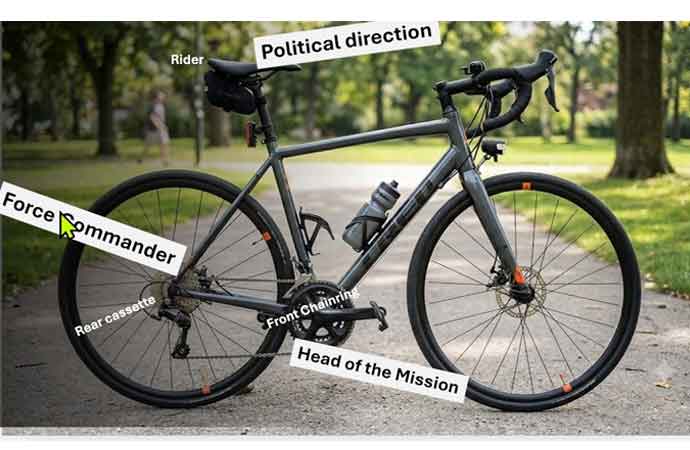
When political direction is incoherent, like the rider not being able to transmit the power, or when the HoM and FC work at cross-purposes, like a crossed chain in the bicycle, or even when the HoM is unable to perform, like malfunctioning of the front chainrings, or is Self interested, the mission is likely to stall or derail. In short, failure to maintain political primacy and lack of coherent civil-military partnership can have grave consequences for peace and stability.
Three examples from earlier peacekeeping are worth repeating. In Somalia, before the United Nations Operation in Somalia UNOSOM peacekeeping mission was deployed, Sahnoun, the SRSG, had convinced the powerful local warlord, General Mohamed Farrah Aidid, to accept the deployment of 500 unarmed peacekeepers to escort humanitarian convoys. However, without consulting either the SRSG or Aidid, UN Secretary-General Boutros Boutros-Ghali recommended deploying 3,500 additional armed peacekeepers to Somalia on 24 August 1992. Whatever influenced the SG, the Somali National Alliance SNA militia strongly opposed the deployment. What followed thereafter in Somalia is a dark chapter in the UN’s history. The Rwanda genocide of 1994 is a reminder of this. The Head of the Mission never left his apartment and left everything to the Force Commander Romeo Dallaire, Shake Hands with the Devil, Da Capo Press, 2003. In South Sudan, on 24 February 2020, David Shearer, the Head of the Mission of UNMISS, when suggested by one staff officer that the mission was expected to do more to protect civilians regardless of how they suffer, his HoM response was, “Most of those people were killed in inter communal violence, which isn’t our job to prevent” Edward H. Carpenter, Blue Helmet, 2025. His stance was akin to saying “not my circus, not my monkeys,” laying the blame elsewhere. The risk-averse mindsets of mission leaders can demotivate those who prioritise protecting civilians. This example shows the need for congruence between politics and the use of military force to achieve the stated objective.
However, when politics itself drives the conflict, the context changes. This is especially true when authoritarian leaders who benefit personally from prolonged conflict undermine the primacy of politics and use it to advance their personal interests instead of resolving conflict. This is evident in the current ongoing conflicts in Europe and the Middle East, where politics is the primary driver, disregarding the use of military force to resolve the conflicts and with utter disrespect for the laws of war. Examples include the war in Ukraine, the civilian suffering caused by Israeli military operations in Gaza and Lebanon, and the conflict in Iran. At the same time, as competition for geopolitical influence intensifies, new power centres emerge. As Gen. Ahuja observed, the trilateral defence agreement among Saudi Arabia, Türkiye, and Pakistan reflects the rise of such new regional power blocs. While this agreement shows the congruence of political objectives and military contributions to achieve them, it is still an arrangement in the making. The primacy of politics in Ukraine, Gaza and Iran has clearly not been allowed to work because of self-serving world leaders.
The failure of political primacy is not due to a deficit of mature statesmanship, but to the structural forces governing the world and the powers that dominate the present world order