Tactical Rapprochement, Economic Leverage and the Imperative of Strategic Preparedness
Yun Sun's article, "China's Strategic Reassessment of India" offers a valuable perspective on Beijing's
evolving perception of India and the strategic calculations shaping the recent improvement in bilateral relations.
Its central argument—that China's renewed engagement with India reflects tactical recalibration rather than a
fundamental transformation of strategic intent—deserves serious consideration by Indian policymakers, defence planners
and the strategic studies community.
Out of three and a half decade of service in the Indian Army, I spent 15 years of operational tenures along the
Indio–China border in Arunachal Pradesh and the high-altitude terrain of Leh-Ladakh which includes my command tenure also.
I believe this analysis raises important questions about the relationship between border stability, great-power competition,
economic interdependence and India's pursuit of strategic autonomy.
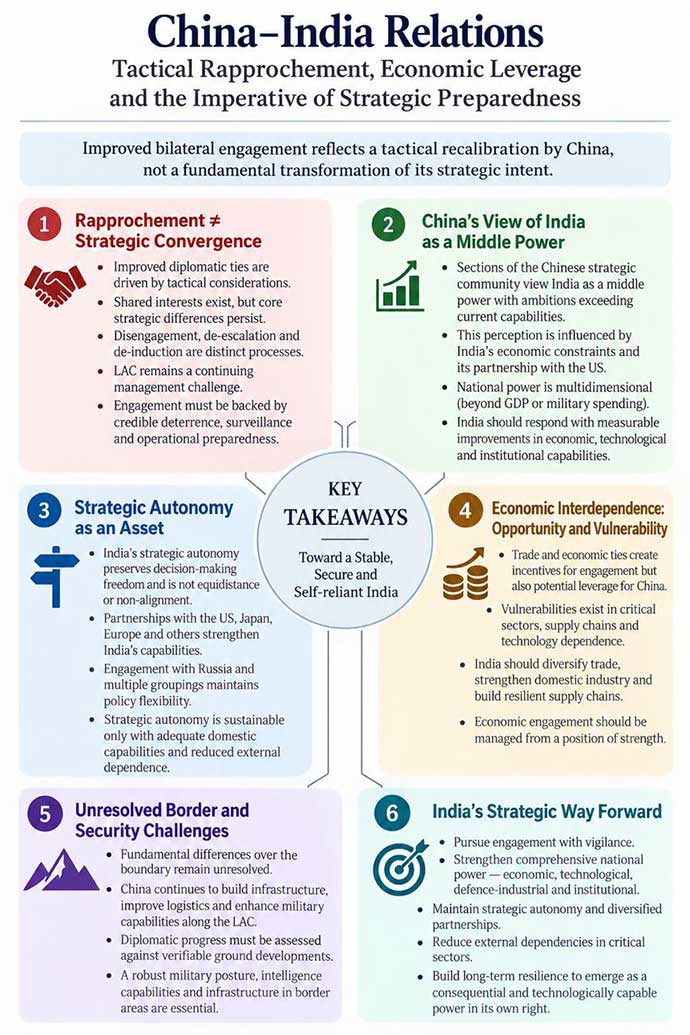
1. Diplomatic Rapprochement Should Not Be Mistaken for Strategic Convergence
One of the article's most significant contributions is its distinction between improving
diplomatic relations and a genuine convergence of strategic interests.
India and China may have compelling reasons to stabilise their relationship.
Both face complex regional and global challenges, while economic considerations create incentives for engagement.
However, these shared interests do not eliminate their competing strategic ambitions, unresolved territorial differences or mutual security concerns.
From a military perspective, disengagement, de-escalation and de-induction are distinct processes.
Progress in one does not automatically establish progress in the others.
Diplomatic engagement must therefore be assessed against verifiable developments on the ground,
including force postures, infrastructure, logistics, surveillance capabilities and the implementation of border agreements.
The Line of Actual Control (LAC) should consequently be viewed as a continuing strategic
management challenge, not a problem resolved merely through improved political communication.
India's policy must combine diplomatic engagement with credible deterrence, persistent surveillance and sustained operational preparedness.
2. China's Perception of India as a Middle Power
Sun argues that sections of the Chinese strategic community increasingly regard India as a middle power whose aspirations exceed its present comprehensive national power. This perception is reportedly influenced by Beijing's assessment of India's economic capabilities, domestic constraints and relationship with the United States.
Such an assessment should neither be dismissed nor accepted uncritically. National power cannot be measured through GDP or military expenditure alone. Geography, demographic scale, technological capability, industrial capacity, institutional resilience, diplomatic influence and the ability to sustain national objectives over time are equally important.
India possesses considerable structural advantages, but converting these advantages into comprehensive national power requires sustained economic growth, technological innovation, defence-industrial capacity and stronger institutional coordination. Equally, India must avoid allowing external perceptions to dictate its strategic self-assessment. The appropriate response to any attempt to limit India's international standing is not rhetorical assertion, but demonstrable improvements in national capability.
India's objective should be to become a consequential and technologically capable power in its own right, rather than a power whose strategic importance depends on the preferences of Washington or Beijing.
3. Strategic Autonomy: An Asset, Not a Liability
The article highlights an apparent Chinese difficulty in understanding India's preference for strategic autonomy and issue-based partnerships rather than permanent alignment with a single major power. This distinction is fundamental to understanding Indian foreign policy.
Strategic autonomy does not imply equidistance between competing powers, nor does it require India to avoid cooperation with countries that share its interests. It preserves the freedom to make independent decisions according to national priorities.
India's partnerships with the United States, Japan, Europe and other Indo-Pacific countries can strengthen its technological, economic and security capabilities. At the same time, its historical relationship with Russia and its engagement with multiple international groupings reflect the practical importance of retaining policy flexibility.
However, strategic autonomy is sustainable only when supported by adequate domestic capabilities. Excessive dependence on external suppliers for critical technologies, defence equipment, energy systems or industrial inputs can constrain freedom of action even when political independence remains intact.
India must pursue strategic autonomy through capability-building, not merely through diplomatic positioning.
4. Economic Interdependence: The Strategic Vulnerability
Perhaps the most consequential aspect of Sun's analysis is its examination of Chinese economic leverage over India. The article cites bilateral goods trade of approximately US$151.1 billion in FY 2025–26 and an Indian trade deficit of around US$112.1 billion.
The strategic concern, however, extends beyond the size of the deficit. Indian manufacturers depend on Chinese industrial inputs, components, machinery and materials across several sectors. Abruptly reducing these imports without viable alternatives could disrupt domestic production, increase costs and weaken export competitiveness.
This creates a strategic dilemma: dependence cannot be eliminated overnight, but allowing critical dependencies to persist indefinitely can expose India to supply disruptions and external economic pressure.
The appropriate response is not indiscriminate economic decoupling. It is selective de-risking and the progressive development of credible domestic and international alternatives.
- Semiconductors, electronics and critical industrial components.
- Pharmaceuticals and their active ingredients.
- Batteries, critical minerals and advanced materials.
- Telecommunications, power systems and strategic digital infrastructure.
- Defence manufacturing, aerospace and dual-use technologies.
- Production-linked incentives, research and development, technology partnerships,
diversified procurement and reliable supply-chain mapping must work together as
elements of a national economic-security strategy. Trade policy must also seek
better market access for Indian products and address persistent structural imbalances.
Economic interdependence can create mutual benefits, but concentrated dependence in strategically indispensable sectors can also create coercive leverage.
5. The Military Dimension: Deterrence Requires Sustained Preparedness
My experience serving along the northern borders both in Arunachal Pradesh and Leh-Ladakh reinforces the importance of assessing strategic intent through capabilities and actions, not diplomatic messaging alone.
In high-altitude operational environments, infrastructure, logistics, road connectivity, communications, surveillance and the ability to sustain troops through severe winters can significantly influence military options.
India must continue strengthening border infrastructure and operational readiness while investing in indigenous surveillance systems, unmanned platforms, secure communications, artificial intelligence-enabled intelligence analysis and resilient logistics.
Technology should complement, rather than replace, sound military judgement and trained personnel. AI-enabled decision support, persistent observation and improved situational awareness can help reduce response times and strengthen deterrence, provided these systems are reliable, secure and appropriately governed.
Preparedness is not incompatible with peace. Properly designed, it helps create the conditions in which diplomacy can operate from a position of confidence.
6. Beyond the Bilateral Relationship: The Wider Geopolitical Context
The article places considerable emphasis on changes in US–India relations and their influence on Chinese perceptions. This is a useful reminder that the India–China relationship cannot be analysed in isolation from the wider international system. Nevertheless, Beijing's interpretation of Washington's intentions is only one variable in a much larger strategic equation.
India's policy must account for developments across the Indo-Pacific, relations with Russia, the security implications of Pakistan's partnership with China, maritime competition, emerging technologies and the changing structure of global supply chains.
The challenge is to preserve flexibility without allowing strategic ambiguity to become strategic indecision. India should deepen partnerships where interests converge, maintain channels of communication with competitors and strengthen its ability to act independently when national interests require it.
7. A Critical Qualification to the Article's Thesis
While Sun's analysis is persuasive in highlighting the possibility of tactical recalibration, an important distinction must be maintained between the perceptions of Chinese analysts and established Chinese state policy.
The views of interlocutors and strategic specialists provide valuable insight into Beijing's possible calculations, but they should not automatically be treated as a definitive statement of the Chinese leadership's intentions.
Similarly, improved relations need not be entirely tactical to remain reversible. Diplomatic engagement can produce genuine, limited areas of cooperation without resolving fundamental disagreements.
India should therefore avoid two opposite errors: interpreting every diplomatic overture as evidence of strategic goodwill, or assuming that every improvement in relations is necessarily deceptive.
The more prudent approach is to test diplomatic intentions against observable behaviour, reciprocal commitments and sustained implementation.
8. The Way Forward for India
First, maintain credible border deterrence. Continue developing infrastructure, intelligence, surveillance and logistics while pursuing verifiable agreements to reduce the risk of confrontation.
Second, strengthen the domestic technological and industrial base. Reduce critical external dependencies through indigenous research, manufacturing and diversified supply chains.
Third, operationalise strategic autonomy. Build partnerships that expand India's choices rather than create new, concentrated dependencies.
Fourth, integrate economic security with national security. Treat critical supply chains, industrial capacity, technological sovereignty and trade resilience as essential elements of comprehensive national power.
Fifth, deepen China expertise. Indian universities, military institutions, think tanks and policy organisations need stronger interdisciplinary research integrating Chinese language and politics, military strategy, economics, technology and regional studies.
Conclusion: Engagement Without Complacency
Yun Sun's article is a timely contribution to the debate on India–China relations. Its principal value lies in reminding us that diplomatic warmth must be interpreted in the context of enduring strategic competition and economic interdependence.
For India, the objective should not be to secure validation of its great-power status from Beijing, nor to depend on another major power to guarantee its strategic position. It should be to develop the economic strength, technological competence, military preparedness and diplomatic flexibility necessary to safeguard its interests independently.
Peace on the border is desirable. Stable relations are necessary. But neither can substitute for comprehensive national power.
My enduring lesson from fairly long tenures along the India–China frontier is that vigilance and diplomacy are complementary instruments of statecraft.
India should engage China where cooperation is possible, negotiate firmly where interests diverge, and remain prepared for circumstances in which diplomacy alone may prove insufficient.
Strategic maturity lies not in choosing between engagement and preparedness, but in sustaining both.
About the Author:
Col (Dr) Dinesh Kumar, is an Alumnus of DSSC Wellington and
holds a Ph D in International Cooperation for Protection of Critical Information Infrastructure.
He currently serves as a Professor at IPS Academy, Indore teaching & guiding research in
Cybersecurity & Artificial Intelligence. He also mentors defence startups associated with
Incubation & Innovation Hub at SGSITS, an Engineering Institution of prominence in Central India.
The views expressed in the commentary are his own.